How the Healthy Heart Works
Quick Facts
- The heart has four chambers.
- Chambers are separated by a wall of tissue, or septum.
- Four heart valves help blood pump through the chambers.
- Congenital defects are related to a problem with the heart’s structure or how it works.
The normal heart is a strong, hard-working pump made of muscle tissue. It’s about the size of a person’s fist.
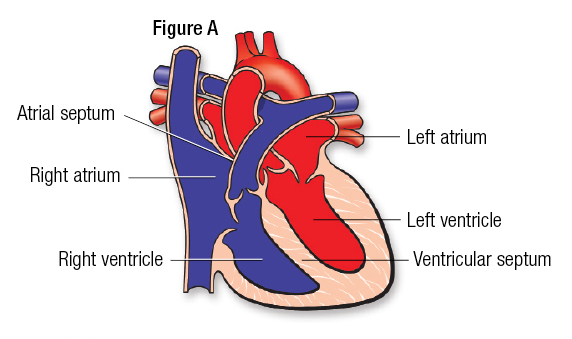
The heart has four chambers. The upper two chambers are the atria, and the lower two are the ventricles (Figure A). The chambers are separated by a wall of tissue called the septum. Blood is pumped through the chambers, aided by four heart valves. The valves open and close to let the blood flow in only one direction.
Congenital defects may involve a heart valve, a chamber, the septum, a major blood vessel or the way blood flows through the heart.
The four heart valves are:
- The tricuspid valve, between the right atrium and the right ventricle
- The pulmonary valve, between the right ventricle and the pulmonary artery
- The mitral valve, between the left atrium and left ventricle
- The aortic valve, between the left ventricle and the aorta
Each valve has a set of “flaps” (also called leaflets or cusps) that open and close to control blood flow. The mitral valve normally has two flaps. The other heart valves have three.
Healthy heart blood flow patterns
In a healthy heart, blood flows in a continuous cycle: body → heart → lungs → heart → body. Next, we will look at each step.
From the body to the heart
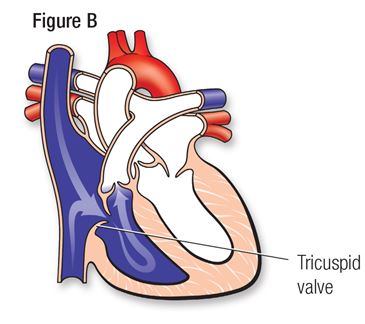
Blood that is low in oxygen (shown as dark bluish blood in Figure B) returns to the heart after moving through the body. It travels through the veins and enters the right atrium. From there, it flows through the tricuspid valve (B) into the right ventricle.
From the heart to the lungs
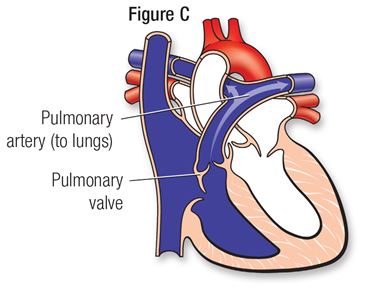
The right ventricle pumps the blood at lower pressure through the pulmonary valve into the pulmonary artery. The blood then travels to the lungs, where it receives oxygen (C).
From the lungs to the heart
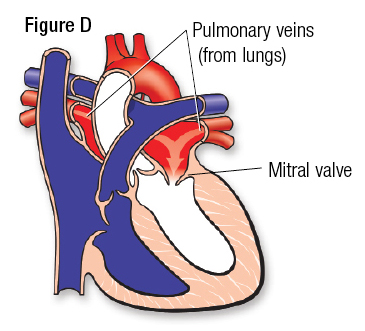
After picking up oxygen in the lungs, the blood becomes bright red. It returns to the heart through the pulmonary veins and enters the left atrium. The blood then passes through the mitral valve (D) into the left ventricle.
From the heart to the body
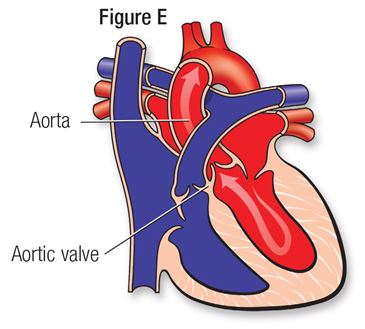
The left ventricle pumps oxygen-rich blood through the aortic valve into the aorta (E). The aorta carries blood to the rest of the body. The pressure generated by the left ventricle is reflected in the arterial blood pressure measured in the arm.


