Awardee's early awareness shaped her sustained commitment to improving community health
By Felicia Fuller
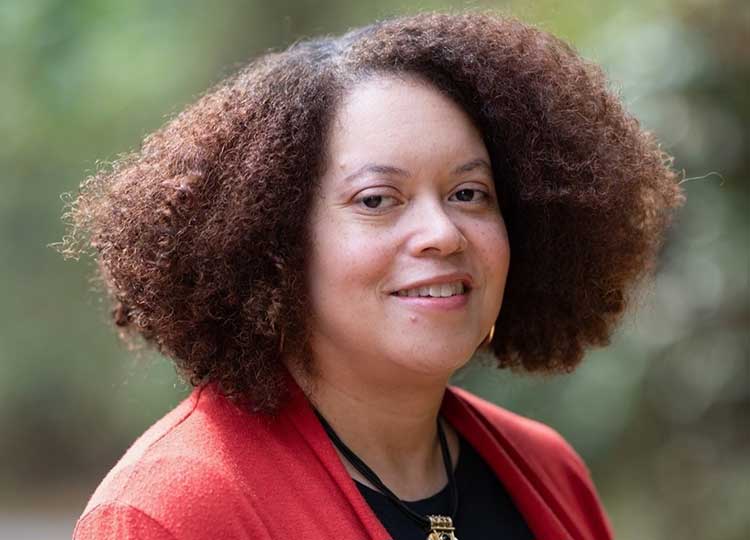 Dr. Tiffany Powell-Wiley’s research focuses on the social determinants of obesity-related risk factors that contribute to racial and ethnic disparities in cardiovascular disease. (Photo by Tigran Markaryan)
When Dr. Tiffany Powell-Wiley was coming of age in 1980s Detroit, the city was experiencing an economic crisis. Auto plant closures caused historic unemployment, and the mass flight of white families to the suburbs left a disinvested urban core. Amid it all, Powell-Wiley’s parents carved out a comfortable living in their inner-city neighborhood, enabling her to thrive.
“I had a great childhood — my mother was a librarian, and my father was an auto industry executive,” she said. “Even though I didn't want for anything, I could see what was happening in our community in terms of job loss, gun violence and limited access to good housing and healthcare.”
Powell-Wiley’s parents emphasized the importance of education and using it to make a positive impact. A science and math whiz, Powell-Wiley explored engineering and medicine, eventually graduating summa cum laude with a bachelor of science degree in chemical engineering from the University of Michigan at Ann Arbor. She also earned a master of public health degree in epidemiology from the University of North Carolina at Chapel Hill.
The turning point came when Dr. Brenda Armstrong, then associate dean of admissions for Duke University School of Medicine, met one-on-one with Powell-Wiley in Michigan to personally invite her to consider attending the school. Armstrong, who was only the second Black woman in the United States to earn board certification in pediatric cardiology, was devoted to diversifying Duke’s student body with star scholars.
Powell-Wiley accepted the offer. Coupled with a clinical rotation at the Veterans Administration Hospital, this experience redirected her focus to cardiology.
“As a fellow, I saw that many patients in their 30s and 40s with obesity had early onset cardiovascular disease,” she said. “That's when I got interested in how the neighborhood environment shapes risk factors.”
Today, Powell-Wiley is an Earl and Thressa Stadtman senior investigator and chief of the Social Determinants of Obesity and Cardiovascular Risk Laboratory at the National Institutes of Health (NIH), with an appointment in the Cardiovascular Branch of the Division of Intramural Research at the National Heart, Lung, and Blood Institute (NHLBI). She is also an adjunct senior investigator in the Intramural Research Program of the National Institute on Minority Health and Health Disparities.
In 2012, she and her team came up with the concept for a community-based research hub, to make research participation more accessible and relevant. But with no permanent location, they were fortunate to be able to use space in local churches. Ten years later, they launched The NHLBI Hope Center in the Edgewood housing complex on the northeast side of Washington, D.C. The predominantly Black and historically under-resourced area offers few healthy food sources and virtually no green spaces for physical activity, increasing chronic disease risk.
“It’s a dedicated space for doing clinical research and engaging community members in health education to help address high rates of diabetes, obesity, cardiovascular disease and cancer,” Powell-Wiley said.
The NHLBI Hope Center hosts active studies focused on women’s health, the cardiovascular impact of community lifestyle, and the efficacy of digital wearables to monitor physical activity. Colleagues from the National Human Genome Research Institute are also on site examining how virtual reality can help people understand their chronic disease risk.
“Future goals include expanding studies to heart failure and cardiomyopathies and adding echocardiography capability,” she said.
Scaling the model will also involve diversifying collaborations, mentoring new investigators, and integrating new treatments and technologies. Powell-Wiley and her husband, Dr. Kenneth Wiley Jr., chief of the Clinical Research Resources Section at the NIH's National Center for Advancing Translational Sciences, are collaborating on artificial intelligence tools that can aid the center’s researchers.
For her contributions, Powell-Wiley is the 2026 recipient of the American Heart Association’s Louis B. Russell, Jr. Memorial Award. Named for a Black teacher and Association volunteer who survived six years after a heart transplant in 1968, the award honors outstanding service in advancing health and hope for everyone, everywhere. Powell-Wiley will be recognized at the Association’s National Volunteer Awards ceremony in Irving, Texas, on June 23.
Dr. Stacey E. Rosen, the American Heart Association’s volunteer president, said Dr. Powell-Wiley’s novel concept for a community-based research hub is a model for meeting people where they are — building trust and engaging under-resourced populations in studies examining the social determinants of obesity and cardiovascular risk.
“Guided by a deep devotion to research, community partnerships and education, the work she is leading will help change the trajectory of health in Washington, D.C., and beyond,” said Rosen, who is also executive director of the Katz Institute for Women’s Health and senior vice president of women’s health at Northwell Health in New York City.
The award is particularly meaningful for Powell-Wiley because it also recognizes her collaborators while placing her among past recipients who influenced her career.
“I came to the NIH as a medical student participating in the NIH Medical Research Scholars Program. That’s when I fell in love with research, and that’s how I was introduced to the American Heart Association. The Association has been part of this journey from the start,” she said.
Over the years, Powell-Wiley has led the Obesity Committee of the Council on Lifestyle and Cardiometabolic Health as chairperson, co-authored scientific statements and guidelines on cardiovascular-kidney-metabolic (CKM) syndrome, and served as associate editor of the Journal of the American Heart Association.
“My husband Kenneth and my 12-year-old son have given me the grace and space to be able to do the work, and I am so grateful,” she said. “They are everything to me.”
 Dr. Tiffany Powell-Wiley and her husband, Dr. Kenneth Wiley Jr., with their son. (Photo courtesy of Tiffany Powell-Wiley)


