Learn more about CPR and How It Can Support You in an Emergency
What does CPR stand for?
CPR stands for Cardiopulmonary Resuscitation.
What is CPR?
CPR – or Cardiopulmonary Resuscitation – is an emergency lifesaving procedure performed when the heart stops beating. Immediate CPR can double or triple chances of survival after cardiac arrest.
Learn more about CPR(link opens in new window)(link opens in new window)
Who can do CPR?
Anyone can offer CPR in an emergency. You don’t need medical training and the AHA does not mandate a minimum age requirement for learning CPR. The ability to perform CPR is based more on body strength than age. Studies have shown that children as young as nine years old can learn and retain CPR skills.
When was CPR invented?
CPR has evolved over hundreds of years. The American Heart Association helped advance CPR as a proven lifesaving skill in the 1960s.
Learn more about the history of CPR(link opens in new window)(link opens in new window)
What is Hands-Only CPR?
Hands-Only CPR uses chest compressions without rescue breaths and can be a helpful option for adults who suddenly collapse. Infants and children, though, still benefit from CPR with breaths.
- Learn more about Hands-Only CPR(link opens in new window)
- View Hands-Only CPR Resources(link opens in new window)
Watch this short video to help you get familiar with how to perform Hands-Only CPR.
Common myths and facts about performing CPR
- “I could get in trouble for trying.” Good Samaritan laws are designed to protect people who offer help in good faith.
- “I might hurt someone.” When a person’s heart has stopped, CPR gives them a chance at survival. Feeling nervous is understandable, yet doing something is almost always better than doing nothing.
- “Children don’t need CPR or AEDs.” Children can experience cardiac arrest too, and CPR and AEDs can help.
- “I must give mouth-to-mouth.” Hands-Only CPR is an effective option for most teens and adults.
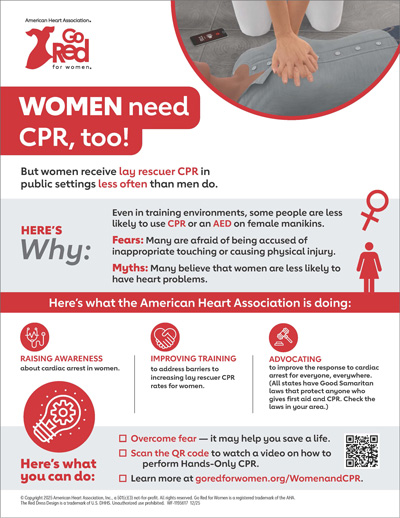
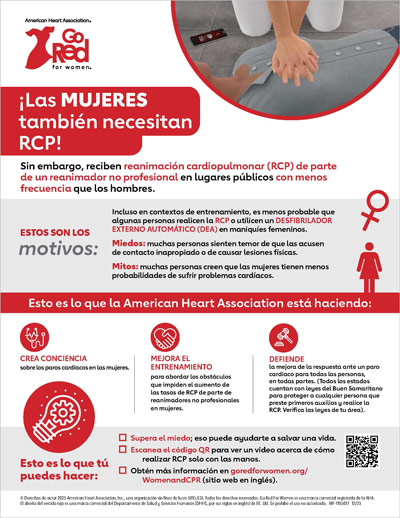
- “Women don’t need CPR.” Everyone deserves quick action during a cardiac emergency. CPR works regardless of gender.
How long does a CPR training class take?
Time commitments vary, depending on whether the class you choose is online, in person, or blended. We recommend that you plan on 1 to 3 hours of in-person time commitment. Pick what fits your comfort level and schedule.
How do I find and manage my CPR course completion card?
Visit our How to Manage your AHA eCard page for ways to find and manage your CPR course completion card.
What is an AED?
An automated external defibrillator (AED)(link opens in new window) is a lightweight, portable device. It delivers an electric shock through the chest to the heart when it detects an abnormal rhythm and changes the rhythm back to normal.
Who can use an AED?
AEDs are designed so that anyone can use them. They provide simple verbal and visual instructions that walk you through what to do. While training can build confidence, it isn’t required.
- Download What Is an Automated External (AED) Defibrillator - English (PDF)(link opens in new window)
- Download What Is an Automated External (AED) Defibrillator - Spanish (PDF)(link opens in new window)
- Download Automated External Defibrillator (AED) Fact Sheet - English (PDF)(link opens in new window)
- Download Automated External Defibrillator (AED) Fact Sheet - Spanish (PDF)(link opens in new window)
Learn more about CPR training(link opens in new window)
View Frequently Asked Questions about CPR training(link opens in new window)
Need help finding the right CPR course?
Use the CPR & First Aid Course Catalog Search so we can help you find the correct course. If a course is required for work, always make sure to check with your employer to ensure you are selecting the correct course.
Course Catalog Search(link opens in new window)
Where do I find a CPR class near me or online?
We offer formal in-person, online, and blended in-person with online classes that fit your comfort level and schedule. Many people like starting with a short, hands-on class, while others prefer learning online first.
CPR in Schools
The CPR in Schools® With First Aid training kit teaches CPR, how to use an AED and basic first aid in just one class period. The easy-to-use kit can be facilitated by anyone and teaches 10 to 20 students at one time.
Cardiac Emergency Response Plan (CERP)
The American Heart Association Cardiac Emergency Response Plan (CERP) is a written document that establishes the specific steps to reduce death from cardiac arrest in any setting – be it a school, community organization, workplace, or sports facility.