Dad felt healthy, but a heart test led to quadruple bypass surgery
By Diane Daniel, American Heart Association News



During a routine physical, Alex Lasprilla asked his doctor for any and all diagnostic tests that might apply to him. At 53, he wanted to make sure he was on the right track.
Alex’s doctor ordered basic blood work and suggested one other test based on his history of intermittently high cholesterol.
“You could get a calcium score test,” she said.
Also known as a coronary artery calcium test, it measures calcium buildup in the coronary arteries. The scan can detect a buildup of a fatty substance called plaque, which can narrow or block arteries.
The CAC test may be recommended for some adults at borderline or intermediate risk of heart disease.
Alex, who lives in Charlotte, North Carolina, felt totally fine and knew of no heart disease in his family. Not in a rush, he got around to the test a couple of months later.
Test reveals a hidden heart risk
The day after Alex’s test, his doctor called. Alex needed to see a cardiologist as soon as possible. His calcium score showed he had extensive calcified plaque, which put him at high risk of coronary artery disease.
The cardiologist also ordered a stress test.
Alex was hooked up to an electrocardiogram, or ECG, monitor to measure his heart rhythm during exercise. The stress test results indicated myocardial ischemia, which happens when reduced blood flow in the arteries in the heart deprives the heart muscle of necessary oxygen and nutrients.
“Maybe there’s some kind of mistake,” Alex told the doctor. “In fact, I was just pulling my son on a sled up and down hills all weekend.”
Alex then underwent an angiogram, which uses X-rays and contrast dye to show blood flow through the heart’s arteries.

Blocked arteries lead to bypass surgery
The angiogram showed four coronary arteries were each 90% blocked. He needed a quadruple bypass.
“With your level of fitness, you’ll bounce right back,” the cardiologist told Alex.
Alex was told that his heart issues were hereditary. Indeed, he later learned that his family did have a history of heart disease, but no one had ever mentioned it.
The surgery in March went well, but Alex’s recovery was challenging. He had to sleep upright for several weeks. He also felt strange sensations in his arms and legs where doctors took the arteries to use as grafts in the surgery.
Life after quadruple bypass surgery
Alex took nearly three months off from his job as a software engineer. He also went through cardiac rehabilitation.
“Rehab was great because it gave me the confidence to know what I could do,” he said. “Now I know that if I’m good there, that means I’ll be good at home, and I won’t worry.”
His wife, Krystin, said the family already ate a heart-healthy diet. Now they’re paying even more attention to diet and exercise.
“Mostly we just feel very thankful for everything,” she said. “This has been a reconfirmation that going to your doctor and having diagnostic tests is important.”
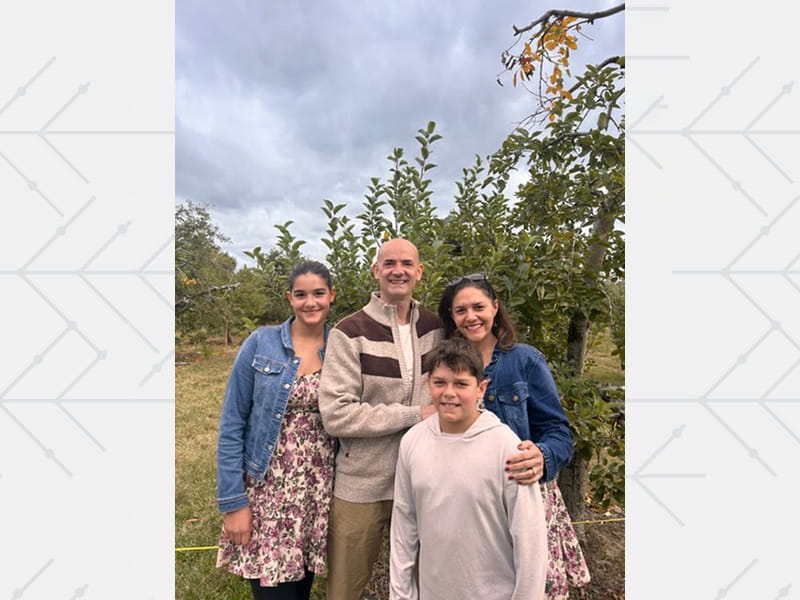
Alex’s experience shows that heart disease can develop without obvious symptoms. Learn more about your own heart health with My Life Check, an online tool based on Life’s Essential 8 that helps you understand your risk for heart disease and stroke.
Stories From the Heart chronicles the inspiring journeys of heart disease and stroke survivors, caregivers and advocates.