How a stroke changed a Chicago portrait artist – and the way she expresses herself
By Deborah Lynn Blumberg, American Heart Association News


When Chicago-based portrait artist Minnie Watkins lost her brother, Calvin, to COVID-19, she took charge of planning his funeral. The day she finished writing her brother’s obituary, she also had a routine physical exam at her local hospital.
Minnie’s blood pressure and other health markers looked good, her doctor told her. When Minnie stood up to leave the exam room, she stumbled. It was probably a muscle spasm, she thought. Later, at home, the stumbling happened again, and it got worse.
Her first thought was — if I’m sick, who will oversee Calvin’s service and pay for his cremation? Minnie tried to rest. The next day, she still felt off. She told a few friends she couldn’t sleep and was limping. Her longtime friend, Crystal Thomas, and two other friends drove to her house to check on her. They noticed Minnie, who was 56, was slurring her speech and insisted she needed to see a doctor.
In the emergency room, Minnie said, “I think I’m having a stroke.”
As nurses examined her, Minnie noticed her left side was going numb. An hour later, she couldn’t move her left hand or arm. Then her left leg and foot froze.
She was having an ischemic stroke, which happens when blood flow to the brain is blocked. In Minnie’s case, blood flow was blocked on the right side of her brain, affecting the left side of her body. Doctors were unable to say what had caused it; maybe stress.
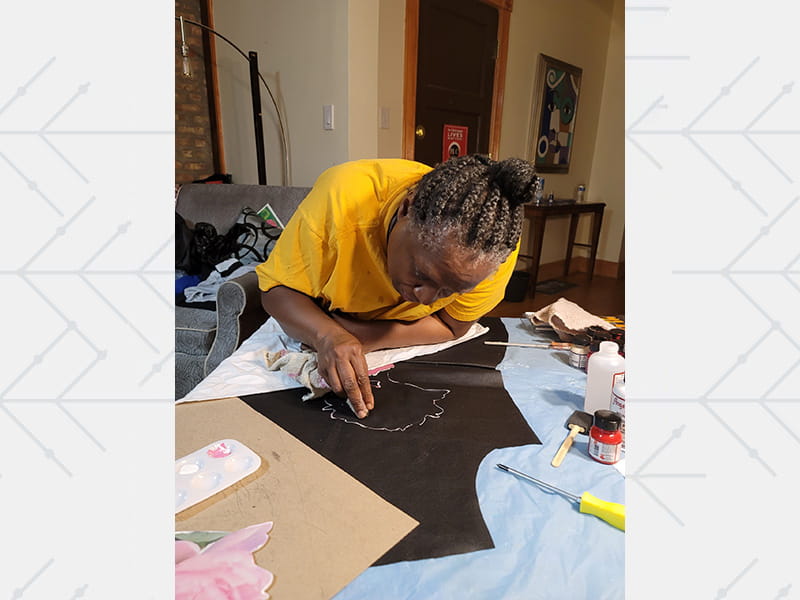
Minnie panicked as she thought about her life as an artist painting realistic portraits. One of her favorite commissions was a painting of American journalist and sociologist Ida B. Wells that ended up in the permanent collection of former Secretary of State Hillary Rodham Clinton. Thankfully, Minnie painted with her right hand. But if something had happened to her brain, would her ability to create art be lost?
She spent several days in intensive care before moving to a regular room the day of Calvin’s funeral. She opted not to watch the livestream, fearing that it would upset her and set back her recovery.
Gradually, Minnie regained feeling on the left side of her body. She learned to walk again, first with a walker, then a four-pronged cane, and finally a regular cane.
The stroke also impaired her vision and ability to recognize faces — a crushing loss for a portrait artist. She struggled to read, too. Working with her therapists, Minnie improved her speech and reading.
After five weeks in the hospital, she spent a month at an inpatient rehab facility for additional therapy. Staff knew Minnie was an artist. They brought paints, brushes and a canvas board to the rec room.
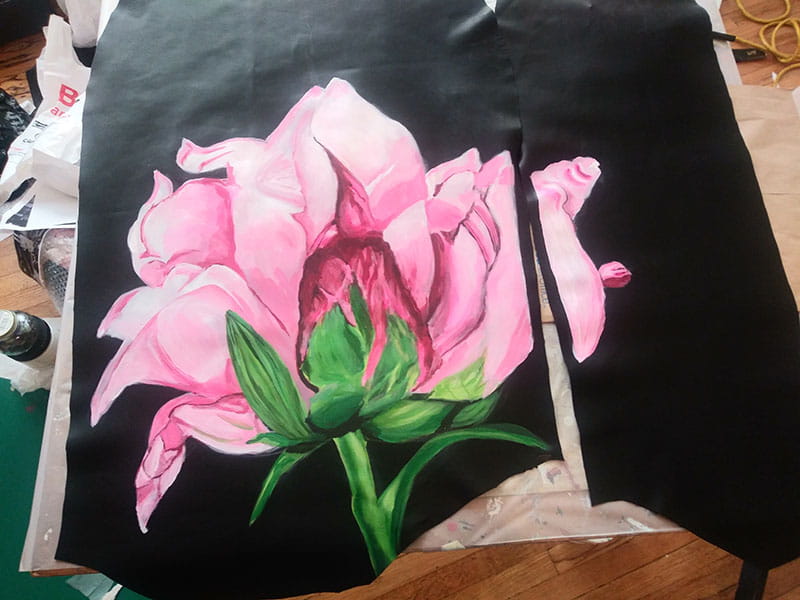
Minnie decided to paint a rose. It was an object she’d painted often for a client who made clothing from the pieces of leather Minnie painted with flowers. But Minnie’s rec-room rose looked nothing like her previous flowers.
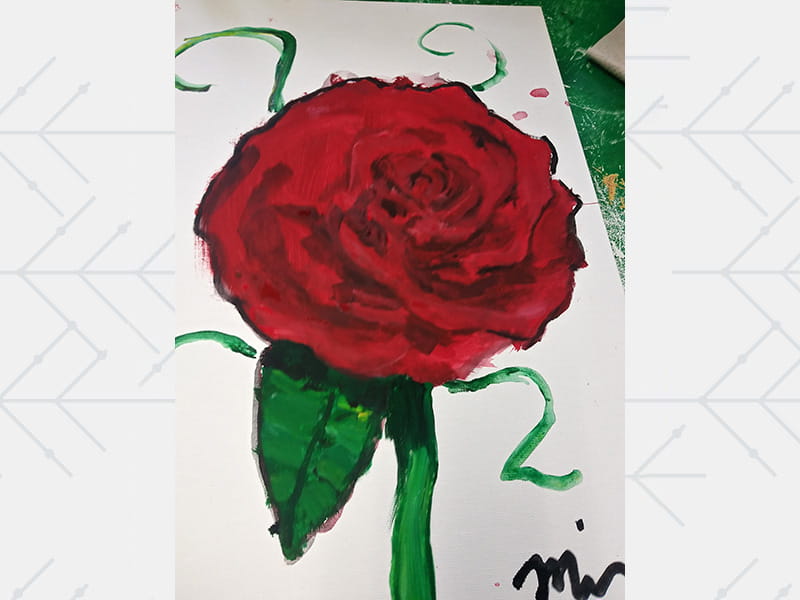
Minnie felt frustrated, defeated. She met with the center’s psychiatrist, a mandatory part of her rehabilitation. It helped to talk to him about her brother’s death, too.
“Why does your art have to keep looking like it’s always looked?” the doctor asked. “There are other ways you can express yourself with art.”
Before her stroke, Minnie had dabbled in abstract art, painting abstract houses, mostly. She enjoyed it before, so she followed the doctor’s advice and tried it again.
Over the next few years, Minnie painted a series of abstract paintings telling her stroke story. Her left fingers and wrist have improved through use of a stretching and strengthening device, as well as Botox treatments.
“I paint with inspiration,” Minnie said. “Some days, I just sit and look at the piece, and that’s a part of the process.”
When her rehab facility celebrated its 60th anniversary, 27 of Minnie’s paintings were displayed in the lobby. One painting, “Sanctuary,” recreated the building’s rooftop garden —a place of solace for Minnie during her stay.
Another painting depicted a face covered with chain-link fencing and barbed wire and chains. In “Left Brain, Right Brain,” the left side of the canvas is black and white; the right side in color.
“Minnie believes in healing and miracles,” her friend Crystal said. “Where she is now may not be where she is in a month or two or a year or two. She’s moving toward greater things.”
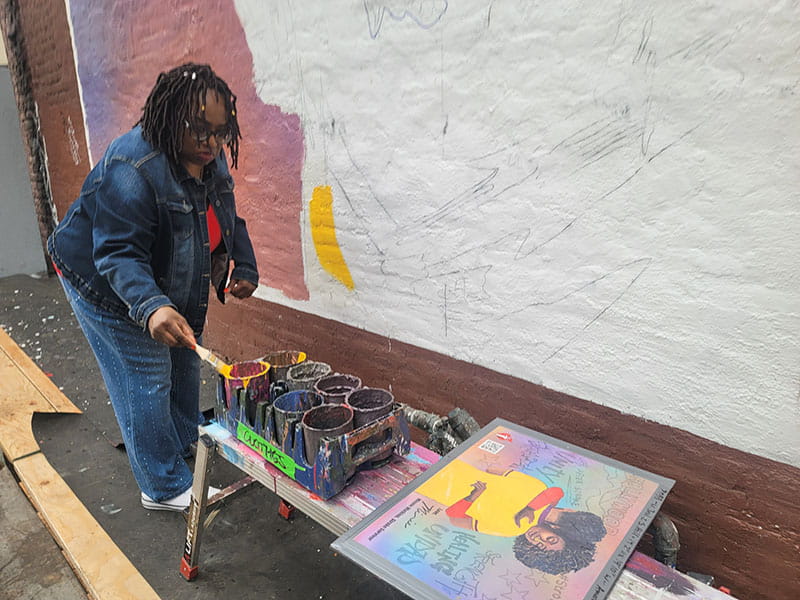
In May 2025, through a partnership with the American Heart Association as part of American Stroke Month, one of Minnie’s paintings was turned into a mural on the side of a restaurant in downtown Los Angeles. She supervised the installation and signed the wall.
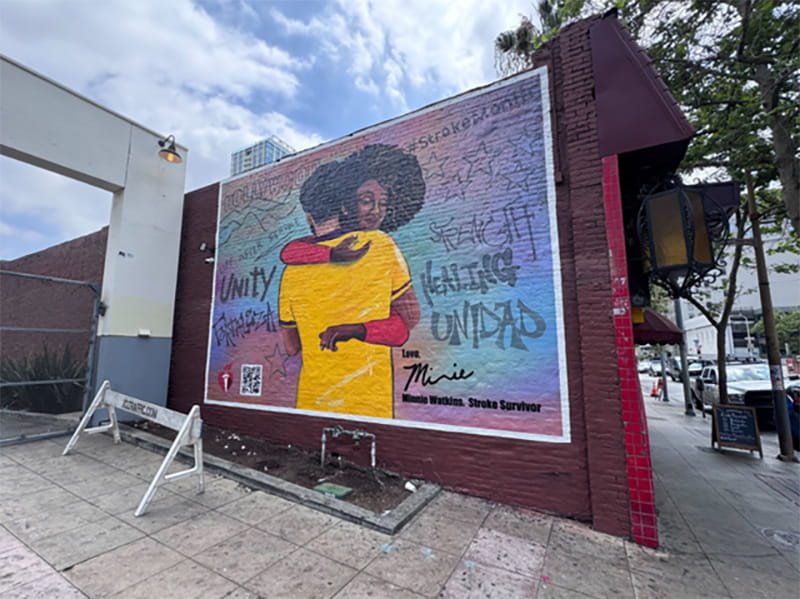
Now 61, she hopes to have her work displayed in a museum. She’s working on a new genre, too: abstract portraiture.
“My art has definitely taken a turn,” she said. “Stroke has really opened up new expressions for me.”
Minnie’s stroke experience reminds us that awareness can be life-changing. Recognizing the warning signs of stroke — and acting quickly — allows you to take action when it matters. Learn the signs with B.E. F.A.S.T.: sudden Balance loss, Eye or vision changes, Face drooping, Arm weakness or Speech difficulty. If you notice any of these, it’s Time to call 911. Take a moment today and explore these signs at Stroke.org/StrokeMonth.
Stories From the Heart chronicles the inspiring journeys of heart disease and stroke survivors, caregivers and advocates.