Updated CPR guidelines aim to save more lives
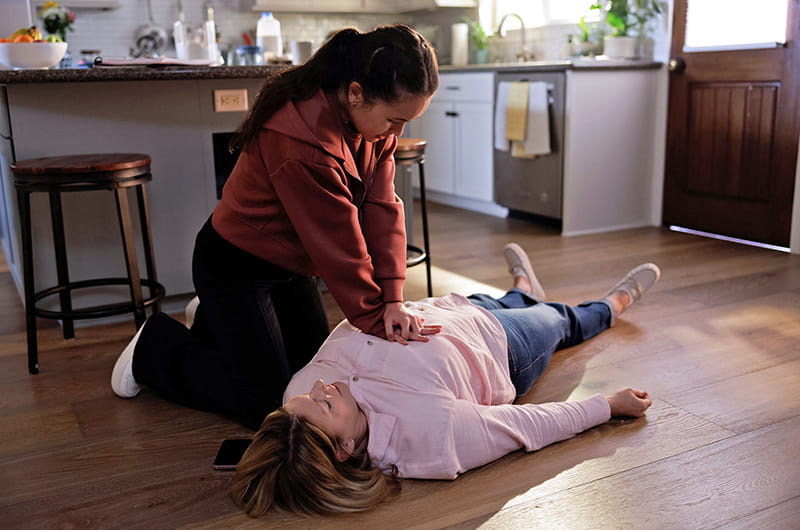
When someone’s heart stops beating, every second counts. Immediate CPR can save lives, yet not everyone knows how to perform it. Updated CPR guidance from the American Heart Association published in October 2025 offers advice to step in and save a life, including recommendations for choking emergencies and suspected opioid overdoses, plus a single chain of survival for all forms of cardiac arrest.
About 350,000 people in the U.S. each year have an out-of-hospital cardiac arrest, an emergency where the heart stops beating. These emergencies result in death about 90% of the time. Receiving CPR right away may double or triple the chance of survival.
That’s why it’s crucial for everyone – not only health care professionals – to learn how to perform lifesaving care. The 2025 guidelines, previously updated in 2020, reflect a comprehensive review of the latest science.
“The American Heart Association’s 2025 CPR guidelines represent gold standard science. It reflects a rigorous examination of the most up-to-date evidence that guides how resuscitation is provided for critically ill patients,” said Dr. Ashish Panchal, volunteer chair of the American Heart Association Emergency Cardiovascular Care Science Committee, physician and professor of emergency medicine at The Ohio State University. “As the science continues to evolve, it’s important that we continue to review new research specific to the scientific questions considered of greatest clinical significance that affect how we deliver life-saving care.”
Choking
In the case of a choking emergency for an adult or child who is conscious, the guidance recommends alternating five back blows followed by five abdominal thrusts. This should be repeated until the object is expelled or the person becomes unresponsive. If the rescuer is unable to encircle the abdomen, such as due to obesity or pregnancy, guidance is to alternate five back blows followed by five chest thrusts.
The guidance for infants is different due to the risk of injury. Alternate five back blows with five chest thrusts using the heel of one hand.
Opioid overdose
In the case of suspected opioid overdose, which is the cause of 80% of all drug overdose deaths worldwide, the update recommends the use of CPR with breaths. The person should also receive a dose of naloxone, a medication that can reduce or reverse some of the effects of opioids.
Signs of an opioid overdose include:
- Slow, shallow or no breathing
- Choking or gurgling sounds
- Drowsiness or loss of consciousness
- Small, constricted pupils
- Blue or gray coloring of the skin, lips or nail beds
Chain of survival
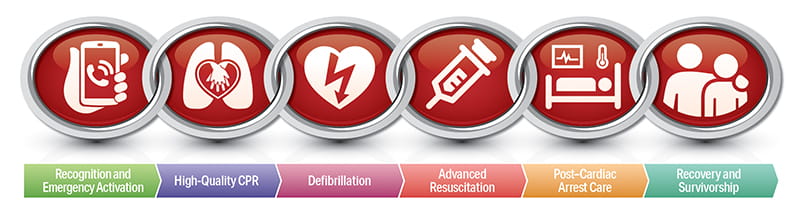
In addition, the guideline provides a single, universal chain of survival for all cardiac arrests, whether adult or child or in the hospital or out of the hospital. The steps are:
- Recognize the emergency and call for help
- Start CPR with compressions and breaths
- Use a defibrillator if available
- Get rescue advanced care
- Get post-cardiac arrest care
- Support recovery
CPR training
The guidelines also offer updates on CPR training, including education for children. Multiple studies show that children ages 12 and older can learn and perform effective chest compressions. With that in mind, the guidance suggests that training should start before age 12, allowing them to grow in willingness and confidence. It also suggests that children ages 4-7 learn how to make an emergency call and follow instructions to use an AED.
“We know high-quality CPR saves lives, and we need dedicated support to ensure that everyone who needs high-quality CPR receives it,” said Panchal. “That starts with learning it yourself. We encourage everyone to take a CPR class to learn the skills and techniques to provide life-saving care in an emergency. Everyone has a role to play in the chain of survival.”
The American Heart Association offers CPR training in person and online. Go to heart.org/nation-of-lifesavers to find a course that’s right for you


