Target: Type 2 DiabetesSM Evidence-Based Activities

Each pillar contains:
- An element of institutional policy or a defined standard of care
- An element of practice assessment compared to the standard
- Specific content associated with strong scientific evidence to improve the care of patients with Type 2 diabetes
Each element is a recommended practice. See the Target: Type 2 Diabetes Pillar Resources & Examples Toolkit for the full rationale and guideline recommendations.
Pillar 1: Assessment
To effectively treat patients with type 2 diabetes, first, clinicians need to ensure proper monitoring and assessment is taking place. This pillar emphasizes evidence-based protocols for monitoring of diabetes and associated risk factors.
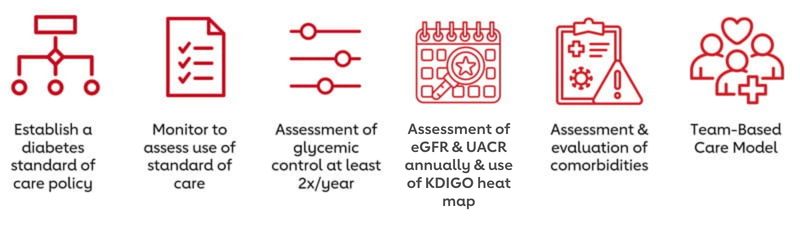
*when clinically indicated
[1] “Standard of care” is inclusive of any policy, protocol, or formally adopted process that is routinely and systematically used across the entire organization as part of standard practice.
[2] Monitored/Monitoring” can be achieved through means such as but not limited to manual chart review, peer review, sampling, or analysis of EMR or population health data, at least annually to assess If the policy/protocol is being followed. This requirement does not specify a level of adherence to the policy/protocol.
[3] “Team-based care model” is inclusive but not limited to internal or external collaboration for the purposes of promoting continuity of care such as partnership with community pharmacies, diabetes educators, specialist referrals, community health workers, etc.
Pillar 2: Treatment
Many treatments exist for the management of type 2 diabetes. This pillar encourages use of standardized treatment algorithms with an emphasis on medications that reduce cardiovascular and kidney risk, both risk factors for diabetes complications.
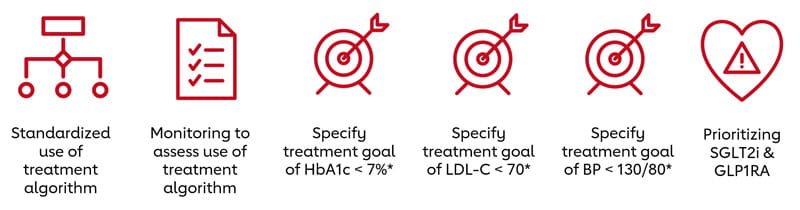
*when clinically indicated
[1] “Standard of care” is inclusive of any policy, protocol, or formally adopted process that is routinely and systematically used across the entire organization as part of standard practice.
[2] Monitored/Monitoring” can be achieved through means such as but not limited to manual chart review, peer review, sampling, or analysis of EMR or population health data, at least annually to assess If the policy/protocol is being followed. This requirement does not specify a level of adherence to the policy/protocol.
[4] “Standardized use” refers to any protocol that is documented or organizationally accepted and is systematically available.
[5] Less stringent glycemic goals may be appropriate for individuals with limited life expectancy or where the harms of treatment are greater than the benefits.
[6] With confirmed hypertension and CVD, or 10-year CVD risk of 10% or greater, or when clinically indicated.
Treatment Resources
Pillar 3: Patient Partnership & Lifestyle Modification
Lifestyle management is a cornerstone of care in diabetes. This pillar focuses on access to support services for lifestyle management to address risk factors and reduce long term risk of diabetes associated complications.
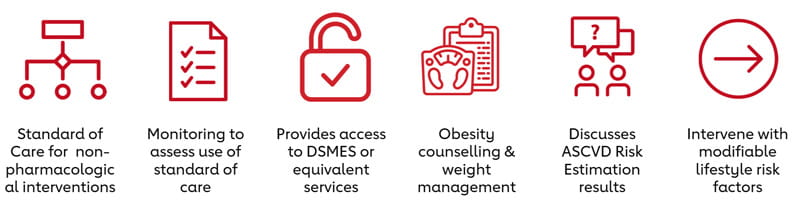
*when clinically indicated
[1] “Standard of care” is inclusive of any policy, protocol, or formally adopted process that is routinely and systematically used across the entire organization as part of standard practice.
[2] Monitored/Monitoring” can be achieved through means such as but not limited to manual chart review, peer review, sampling, or analysis of EMR or population health data, at least annually to assess If the policy/protocol is being followed. This requirement does not specify a level of adherence to the policy/protocol.
[7] Minimum requirements of DSMES or equivalent services include delivery of content addressing 1. Pathophysiology of diabetes and treatment options, 2. Healthy coping, 3. Healthy eating, 4. Being active, 5. Taking medication, 6. Monitoring of blood sugars, 7. Reducing risk (treating acute and chronic complications), 8. Problem solving & behavior change strategies.
Patient Partnership & Lifestyle Modification Resources
Pillar 4: Equitable Health Outcomes
Social Drivers of Health (SDoH) effect many patients with diabetes. It is important to not only screen for SDoH but also provide adequate referrals to address the needs of each patient.

*when clinically indicated
[2] Monitored/Monitoring” can be achieved through means such as but not limited to manual chart review, peer review, sampling, or analysis of EMR or population health data, at least annually to assess If the policy/protocol is being followed. This requirement does not specify a level of adherence to the policy/protocol.
[8] “Standard process” refers to any protocol or practice that is documented or organizationally accepted and is systematically available.