What is an AED? How to use one during a cardiac arrest
By American Heart Association


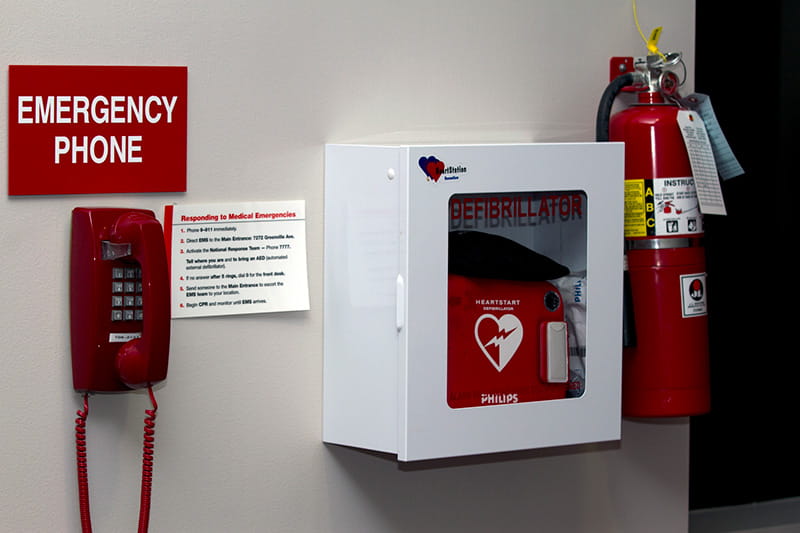
You’ve probably seen them mounted on walls in office buildings, airports, gyms and schools — small boxes marked with a heart symbol and the letters “AED.”
Most people walk right past them. But in an emergency, that device could mean the difference between life and death.
Every year, more than 350,000 adults in the U.S. have an out-of-hospital cardiac arrest. Survival often depends on how quickly someone nearby acts. An automated external defibrillator (AED) is one of the most powerful tools available to save a life — and anyone can use an AED. The device gives step-by-step voice instructions and will only deliver a shock when needed.
Here’s what you need to know about AEDs, how they work, and why you shouldn’t hesitate to use one.
What is an AED?
An automated external defibrillator, or AED, is a lightweight, portable device that can detect certain life-threatening heart rhythms and restore a normal rhythm by delivering an electric shock through the chest.
Why AEDs and CPR improve cardiac arrest survival
CPR and early use of a defibrillator greatly improve the chances of survival for someone in cardiac arrest. But according to American Heart Association statistics, bystanders only administer CPR about 40% of the time, and public AED use is even less common. About 1 in 8 people who have cardiac arrests in a public setting receive a shock from a bystander using an AED.
A defibrillator can be manual, used by trained healthcare personnel to deliver a shock. Or it can be automated, like those commonly found in public spaces. Anyone can use an AED because the device determines whether a shock is needed.
What to do first when someone has cardiac arrest
If someone collapses, make sure the scene is safe. Then check the person for responsiveness. If the person doesn’t respond, shout for help. Have someone call 911 and ask another person to get an AED.
Next, check the person for normal breathing. Sometimes people in cardiac arrest may appear to be breathing with "agonal breaths," which may look like gasping or abnormal breathing.
Begin CPR by pushing hard and fast in the center of the chest at a rate of 100 to 120 beats per minute. In some parts of the U.S., 911 operators can also guide rescuers through CPR.
"Always call 911 first," said Dr. Ashish Panchal, an emergency medicine specialist at Ohio State University's Wexner Medical Center in Columbus. "That gets more help to you. Then push hard and fast."
The chest compressions keep blood flowing to the heart and other organs until a shock can restore a normal heart rhythm or advanced help arrives.
Where to find an AED and how it works
While one person provides CPR, another should locate the nearest AED.
The devices can usually be found in wall-mounted cases in high-traffic areas such as airports, schools and government buildings, even grocery stores and malls. The nonprofit PulsePoint Foundation offers a registry of AEDs and other lifesaving resources located near emergency scenes.
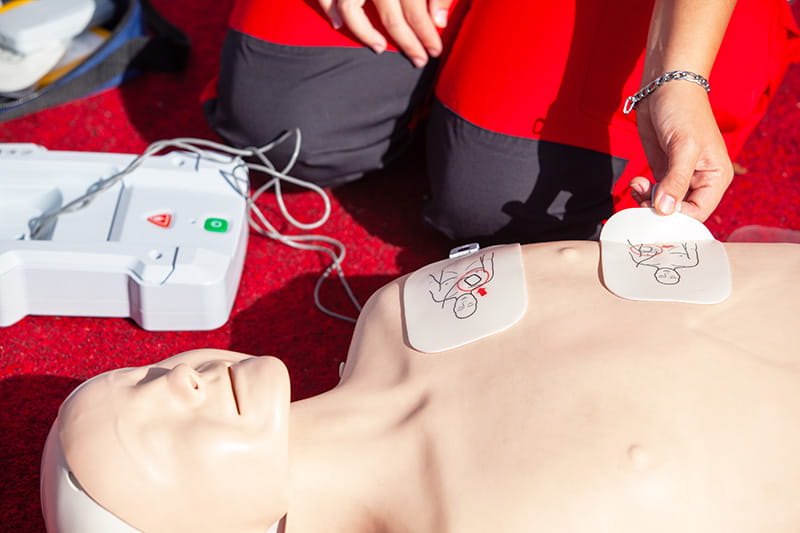
AEDs are designed to be simple and intuitive. Inside the box are pads and a diagram that shows where to place them on the bare skin. Once the device is turned on, a voice tells the rescuer exactly what to do.
The AED first analyzes the person’s heart rhythm to determine whether a shock is needed. CPR should be stopped only when prompted by the machine, such as during rhythm analysis or when providing a shock.
"If no shock is advised, it will tell you to resume CPR,” said Dr. Mary Ann Peberdy, a professor of medicine and emergency medicine at Virginia Commonwealth University in Richmond. If there is a shockable rhythm, the AED will advise the rescuer to stay clear of the person and press the button to deliver a shock.
How to use an AED step by step
Once powered on, the device gives clear voice instructions and will guide you through how to use it.
Follow these steps to use an AED:
- Remove any clothing covering the chest or where the AED pads will be placed. If necessary, wipe the chest dry.
- Turn on the AED and follow the voice prompts.
- Peel away the backing from the pads and attach the pads to the person’s bare chest following the illustration on the pads.
- Plug the pads connector into the AED, if necessary.
- The AED will check to see if the person needs a shock and tell you when to give one. While the AED is analyzing, make sure no one is touching the person.
- Resume CPR if no shock is needed. If a shock is needed, make sure no one is touching the person and press the Shock button, then immediately resume CPR.
- Continue CPR until emergency medical personnel arrive.
Can anyone use an AED?
AEDs are built for the general public, meaning no medical training is required to use them. The device will walk you through every step.
There is also no minimum age required to operate the device. "A child can operate an AED," Panchal said. "Children can also do CPR – and they can do effective CPR." If children are too young or not strong enough, they can call 911 and get immediate help.
Why it’s safe to use an AED
"People should not be afraid to use these devices," Peberdy said. "Many people are afraid of making it worse. You're not going to make it worse. If someone is in cardiac arrest, they are technically dead."
If performed immediately, CPR can double or triple the chance of survival from a cardiac arrest outside of a hospital. "Waiting for emergency medical services to arrive takes up precious, precious time," Peberdy said.
Do Good Samaritan laws protect AED users?
Some people may hesitate to help because they're afraid of the liability, Panchal said. "They worry if they're going to get sued."
Good Samaritan laws are designed to protect people who step in to provide lifesaving care, he said.
"All of us can be a lifesaver," Panchal said. "We can be that individual. We just have to choose to do it. Call 911, push hard and fast and ask someone to get the AED. Those three steps can save a life."
In a cardiac emergency, every second matters – and in many cases, the person who saves a life isn’t a doctor. It’s the person standing nearby. You don’t need to be a healthcare professional to make a difference. Find a CPR and AED training course near you.