After cardiac arrest and CPR, football player eyes a comeback
By Deborah Lynn Blumberg, American Heart Association News


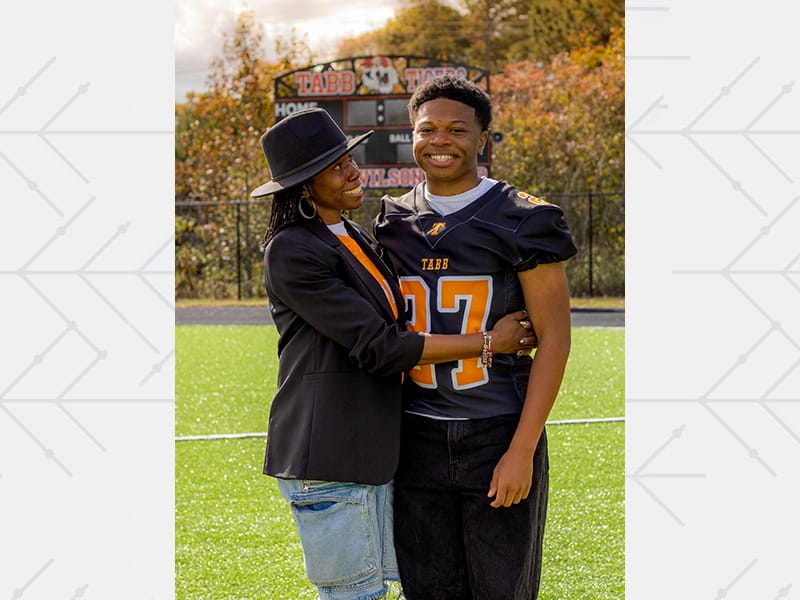
On a July afternoon in Yorktown, Virginia, sophomore Ameer Chambers went through his first day as a member of the Tabb High School varsity football team, the Tigers.
Coaching staff guided the team through squats and bench presses in the weight room, then sent everyone out to run sprints. Ameer crossed the finish line, walked back across the field and collapsed.
Two senior teammates saw Ameer go down and ran to him. Thinking he had a heatstroke, they called for someone to bring water.
Athletic trainer Jeff Wiseman heard the commotion and rushed across the field. He recognized the signs of sudden cardiac arrest and started the chain of survival, the series of steps used to save someone in cardiac arrest outside of a hospital.
Normally, calling 911 is the first step – but because the fire department was next door, the team’s wide receivers coach sprinted there to alert first responders. Jeff started CPR while someone else grabbed an automated external defibrillator, or AED, from behind a goalpost.
Jeff tried to affix the AED pads so he could deliver a shock to try restarting Ameer’s heart. Ameer was so sweaty, the pads wouldn’t stick. Soon enough, the fire department chief was at Ameer’s side; his pads stuck.
The chief shocked Ameer once. Then a second time. Ameer had a stable pulse.
When Ameer woke up in the emergency room, his first thought was that his mom, LaTasha, had gotten hurt. The last thing he remembered was lifting weights.
“I passed out?” he asked LaTasha, repeating the question over and over. “We’re in here for me?” Ameer became so agitated he needed sedation.
Why did a healthy teen have sudden cardiac arrest?
After a few hours, Ameer was transferred to a nearby children’s hospital. He had blood work, an ultrasound to check his heart’s anatomy and a stress test to measure how his heart performed as he exercised.
A few minutes into the stress test, the medical team saw signs of an arrhythmia, an irregular heartbeat, and immediately stopped the test. They couldn’t explain why this was happening.
“Your best route is to get an ICD as a safety net,” the doctor said, referring to an implantable cardioverter defibrillator that can deliver a shock to the heart if it stops or goes out of rhythm. And, the doctor said, Ameer’s football days would have to be over.
The Chamberses wanted a second opinion.
It didn’t make sense to them that a healthy, athletic teenage boy suddenly had heart problems. Ameer had played sports since he was 5 and never had a health issue – until now.
Doctors at a second children’s hospital couldn’t find an explanation either. They, too, recommended an ICD and advised Ameer to stop playing football.
A medical team at a third hospital said the same thing – almost. The one difference was hope that Ameer could eventually play again.
An ICD offers protection – and a second chance
In December 2025, six months after he collapsed, Ameer had an ICD implanted under the skin on the left side of his chest below his armpit. The device is usually placed below the collarbone, but doctors chose a different location so it would be better protected if he was eventually cleared to play football again.
After the holidays, Ameer joined practices, encouraging his teammates and doing lighter weights, fewer sets and stretching. At the end of February, his doctor cleared him to start playing football again – provided that if he felt too tired, he had to slow down.

A setback, but the ICD does its job
One day in March, before he could get back on the field, Ameer was doing jump-training exercises with his team. Partway through, he felt as if a horse had kicked him in the chest.
Ameer fell to his knees. His ICD had shocked him, just like it was supposed to.
Ameer’s doctor prescribed medication to slow his heart rate. They hoped that keeping his heart from beating too fast would help prevent future arrhythmias.
Then Ameer and LaTasha looked at his ICD data. They learned that, a few days prior to the shock, he’d had another irregular heartbeat. That time, his heart self-corrected just before the ICD delivered a shock.
Turning his survival into a mission to save others
While Ameer waited to see if the medication would help, he and LaTasha turned their focus to spreading awareness about how to become a lifesaver.
Ameer helped LaTasha organize CPR training at the community resource center where she works as senior program director. Through training led by the same CPR instructor who taught Jeff, 29 people, from teens to older adults, were trained in CPR and using an AED. Ameer shared his story with participants.
“I’m proud of Ameer,” LaTasha said. “He’s been resilient. He’s a testimony that CPR does save lives, it does work.”

Hoping for a return to football
In early June, another stress test suggested the medication was working: Ameer’s heart rate was slower than expected given the intensity of the workout, and no arrhythmias were detected. His doctor cleared him to play again when he was ready.
“There’s optimism, there’s hope,” LaTasha said. Ultimately, a return to football will be a family decision, she said. They’re looking into protective gear.
Ameer is eager to play again.
“This is the hand God has given me, and I just got to roll with it,” he said. “Watching the guys out there practicing every single day, I want to be out there too. I’m hopeful, optimistic, ready to go. I’m not nervous to get on the field, I’m extremely excited if I get the chance.”
When Ameer Chambers collapsed in cardiac arrest, trained bystanders, CPR and an AED helped save his life. Learning CPR can help you be ready to act in a life-threatening emergency and could help save someone you love. Join the American Heart Association's Nation of Lifesavers and learn CPR.
Stories From the Heart chronicles the inspiring journeys of heart disease and stroke survivors, caregivers and advocates.