Vascular Health: Understanding Artery Disease, Peripheral Artery Disease (PAD) and Blood Clots
Vascular Health Quick Facts
- Vascular refers to the body’s blood vessels, including the arteries and veins that carry blood throughout the body. Vascular conditions affect circulation and blood flow.
- Vascular disease includes a range of conditions that affect blood vessels, such as atherosclerosis, which is the buildup of plaque in arteries. These conditions can lead to reduced blood flow and increased risk of serious health problems, including heart disease and stroke. Vascular diseases can also affect arteries, veins and capillaries. Some are caused by plaque buildup in arteries, while others involve blood clots or problems with blood flow.
- Understanding vascular health can help you notice changes in your body and have informed conversations with your healthcare team.
Conditions such as peripheral artery disease (PAD), carotid artery disease, deep vein thrombosis (DVT) and pulmonary embolism (PE) can affect circulation and may lead to serious health complications. PAD and carotid artery disease are associated with an increased risk of heart attack and stroke. DVT can lead to pulmonary embolism if a clot travels to the lungs. Learning about the symptoms, causes and treatment options can help you take steps to support your vascular health.
What Is Atherosclerosis?
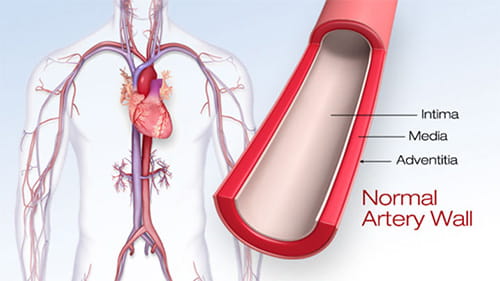
Atherosclerosis is a condition in which plaque builds up inside the arteries. Plaque is made up of cholesterol, inflammatory cells, calcium and other substances. Over time, plaque can narrow the arteries and reduce blood flow throughout the body.
Atherosclerosis often develops slowly and may not cause symptoms at first. It is a leading cause of heart attack, stroke and peripheral artery disease (PAD).
What Causes Atherosclerosis?
Atherosclerosis develops when plaque builds up inside the artery walls over time.
Several factors may increase your risk, including:
- High cholesterol
- High blood pressure
- Diabetes
- Smoking
- Physical inactivity
- Overweight or obesity
- Family history of cardiovascular disease
Healthy lifestyle habits and managing these risk factors can help support artery health.
What Are the Symptoms of Atherosclerosis?
Many people with atherosclerosis do not have symptoms until an artery becomes narrowed or blocked.
Symptoms depend on which arteries are affected. They may include:
- Chest pain (angina)
- Leg pain while walking (claudication)
- Symptoms of stroke
Regular checkups and cholesterol screening can help identify risk factors before symptoms develop.
How Can You Help Prevent Atherosclerosis?
While not every risk factor can be controlled, healthy habits can help lower your risk of plaque buildup and cardiovascular disease.
The American Heart Association recommends:
- Eating a heart-healthy diet
- Being physically active
- Maintaining a healthy weight
- Avoiding tobacco products and e-cigarettes (vaping)
- Getting enough quality sleep
- Managing cholesterol, blood pressure and blood sugar
Small changes over time can help improve your vascular health.
If healthy lifestyle changes alone are not enough to lower LDL “bad” cholesterol, your healthcare team may recommend cholesterol-lowering medication.
Your healthcare team can help you create a treatment plan that works for you.
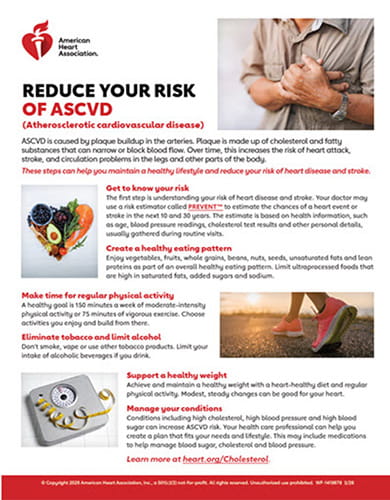
Reduce your risk of ASCVD (PDF)
Learn more:
How Is Atherosclerosis Treated?
Treatment for atherosclerosis focuses on slowing plaque buildup, lowering the risk of heart attack and stroke, and managing conditions such as high cholesterol or high blood pressure.
Depending on your health needs, treatment may include lifestyle changes, medications and regular follow-up with your healthcare team.
The American Heart Association offers tools and resources to help you better understand your treatment options.
Learn more:
- Cholesterol Medications Checklist (PDF)
- How Statins Work (PDF) | Spanish (PDF)
- What Are Cholesterol-Lowering Medications? (PDF) | Spanish (PDF)
- Cholesterol-Lowering Medications Discussion Guide (PDF) | Spanish (PDF)
- My Cholesterol Treatment Plan (PDF)
- My LDL Cholesterol Guide (PDF) | Spanish (PDF)
- How Can I Improve My Cholesterol? (PDF) | Spanish (PDF)
- How Can I Monitor My Cholesterol, Blood Pressure and Weight? (PDF)
- Tips for Talking to Your Doctor About ASCVD (PDF) | Spanish (PDF)
What is Arteriosclerosis?
Arteriosclerosis is a general term for arteries that become thicker, stiffer and less flexible over time. It is often called "hardening of the arteries."
Several conditions fall under the umbrella of arteriosclerosis. The most common is atherosclerosis, which is caused by plaque buildup inside the arteries.
As arteries become stiffer, the heart works harder to pump blood. This can increase the risk of cardiovascular disease.
What's the Difference Between Arteriosclerosis and Atherosclerosis?
Although the terms are often used interchangeably, they are not the same.
- Arteriosclerosis is the general hardening and stiffening of the arteries.
- Atherosclerosis is a specific type of arteriosclerosis caused by plaque buildup inside the artery walls.
Understanding the difference can help you better understand your diagnosis and treatment plan.
What Is Peripheral Artery Disease?
Peripheral artery disease (PAD) happens when the arteries that carry blood away from the heart and brain to other parts of the body are narrowed and blood flow is reduced. This is often caused by plaque buildup in the arteries, a condition called atherosclerosis.
The most common type is lower-extremity PAD. This is when blood flow to the legs and feet is reduced. Some people with PAD notice leg pain while walking. Others may feel heaviness, cramping, fatigue or weakness in their legs. Many people don’t notice symptoms at first.
PAD is linked to overall heart and blood vessel health. Because it affects the arteries, it can also increase the risk of heart attack or stroke.
What Are the Symptoms of Peripheral Artery Disease?
Many people with PAD notice symptoms during physical activity. The most common symptom is leg pain or cramping that starts while walking, exercising or climbing stairs and goes away with rest.
Symptoms may feel like aching, burning, cramping, fatigue or heaviness in the legs. Symptoms can occur in the calf, thigh, buttock, ankle or foot. Because they often develop slowly, they may be mistaken for aging, arthritis or a muscle strain.
Other Signs of Peripheral Artery Disease (PAD)
Some people notice changes in their feet or legs even if they do not have pain. These changes may include:
- Wounds that heal slowly
- Gangrene (dead tissue)
- Cooler skin on one foot or leg
- Changes in skin color
- Slower toenail growth
- Less hair growth on the legs
- Loss of calf muscle
If leg pain or changes in your feet or legs are affecting your daily life, it may help to talk with a healthcare professional.
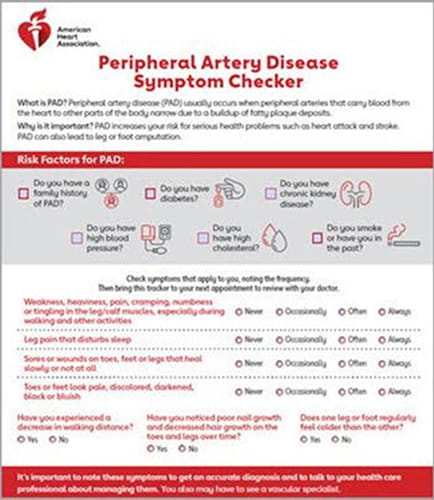
Peripheral Artery Disease symptom checker (PDF)
What Causes Peripheral Artery Disease (PAD)?
PAD is most often linked to atherosclerosis, a condition in which plaque builds inside the arteries over time. This buildup can reduce blood flow to the legs and feet.
Risk factors for PAD include:
- Smoking
- Diabetes
- High blood pressure
- High cholesterol
- Kidney disease
- Family history of cardiovascular disease
- Aging
Some risk factors cannot be changed. Others may be managed with healthy lifestyle habits, medications and ongoing care.
How Does Peripheral Artery Disease (PAD) Connect to Heart Health?
PAD affects more than the legs. Because it’s a disease of the blood vessels, people with PAD may also have a higher risk of:
- Coronary artery disease
- Heart attack
- Stroke
Knowing your risk factors can help you have informed discussions with your healthcare team.
How Is Peripheral Artery Disease (PAD) Diagnosed?
Poor blood flow in the legs can be a sign of PAD. Finding PAD early may help lower the risk of serious health problems, including heart attack, stroke and limb loss.
To diagnose PAD, your healthcare professional will ask about your symptoms, medical history and circulation concerns. During a physical exam, they may also check the pulses and temperature in your legs and feet.
Tests used to diagnose PAD may include:
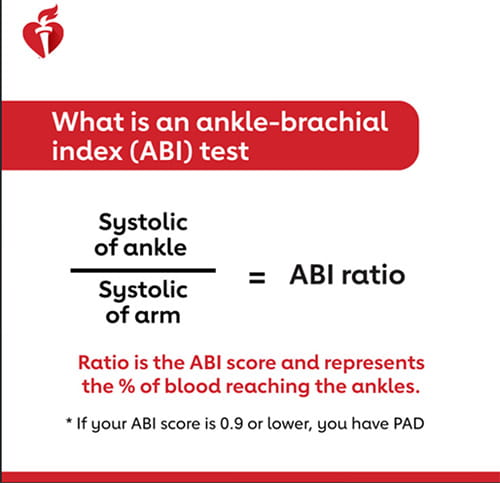
- Ankle-Brachial Index (ABI): This simple, noninvasive test compares blood pressure in your arms and ankles to measure blood flow. An ABI score of 0.90 or lower may be a sign of PAD.
- Imaging tests: Ultrasound, MRI or CT angiography may help identify narrowed or blocked arteries.
- Catheter angiogram: In some cases, a doctor may use dye and X-ray imaging to look at blood flow and find blockages.
Many people live with PAD symptoms for years without realizing their circulation is impaired. Early diagnosis may help lower the risk of complications and support better long-term vascular health.
How Is PAD Treated?
Treatment for PAD may include lifestyle changes, medications or procedures to improve blood flow and help manage symptoms. Your healthcare professional can help determine the best treatment plan for you.
Lifestyle Changes That May Help
Many people with PAD improve their symptoms and circulation by:
- Walking or joining a supervised exercise program
- Quitting smoking
- Eating a heart-healthy diet
- Managing blood pressure, cholesterol and diabetes
Healthy daily habits can support circulation and overall heart health.
Medications
Some people may benefit from medications that:
- Lower cholesterol
- Reduce the risk of blood clots
- Manage blood pressure
- Improve walking distance and leg symptoms
Your healthcare professional can help determine which medications are right for you.
Procedures and Surgery
For some people, minimally invasive procedures or surgery may help improve blood flow. Options may include:
- Angioplasty
- Stent placement
- Atherectomy
- Bypass surgery
The best treatment depends on your symptoms, overall health and personal goals. Talk with your healthcare professional about your options. To prepare for your next appointment, use the PAD Discussion Guide.
Learn more:
What is Carotid Artery Disease?
Carotid artery disease happens when plaque builds up inside the carotid arteries. These are the two major blood vessels in your neck that carry oxygen-rich blood to your brain. As plaque builds up, the arteries narrow, reducing blood flow and increasing the risk of stroke.
Many people do not know they have carotid artery disease because it often does not cause symptoms.
Knowing your risk factors and talking with your healthcare team can help you take steps to protect your brain and heart health.
What Are the Symptoms of Carotid Artery Disease?
Carotid artery disease often causes no symptoms until a transient ischemic attack (TIA) or stroke occurs.
Warning signs may include:
- Sudden numbness or weakness in the face, arm or leg, especially on one side of the body
- Trouble speaking or understanding speech
- Sudden vision loss or blurred vision in one or both eyes, especially temporary vision loss in one eye
- Dizziness or loss of balance
- Sudden, severe headache with no known cause
These symptoms may be signs of a TIA, sometimes called a "mini-stroke," or a stroke. A TIA causes brief stroke-like symptoms and can be a warning sign that a stroke may happen in the future. A stroke can cause permanent brain damage.
Call 911 right away if you notice any of these symptoms. Even if symptoms go away quickly, they should never be ignored.
What Causes Carotid Artery Disease?
The most common cause of carotid artery disease is atherosclerosis. This is a condition in which plaque builds up inside the arteries over time.
Several factors can increase your risk, including:
- High blood pressure
- High cholesterol
- Diabetes
- Smoking
- Physical inactivity
- Overweight or obesity
- An unhealthy dietary pattern
- Family history of cardiovascular disease
- Older age
While some risk factors cannot be changed, many can be managed through healthy lifestyle habits, medication and ongoing care.
How Is Carotid Artery Disease Treated?
Treatment for carotid artery disease depends on how much the artery is narrowed, whether you've had symptoms and your overall health.
Many people manage carotid artery disease with healthy lifestyle changes and medications that help lower cholesterol, control blood pressure and reduce the risk of blood clots. For some people, this may include antiplatelet medication.
If a carotid artery becomes severely narrowed, your healthcare team may recommend a procedure to restore blood flow. Examples include carotid endarterectomy or carotid artery stenting.
Your healthcare team can help you choose the treatment plan that is right for you.
What Is a Carotid Artery Dissection?
A carotid artery dissection occurs when a tear forms in the inner lining of a carotid artery. Blood can enter the artery wall, creating a false channel that narrows or blocks the artery or allows blood clots to form. Carotid artery dissection is an important cause of stroke, especially in younger adults.
Symptoms may include:
- Sudden neck pain or headache
- Temporary vision loss
- Weakness or numbness on one side of the body
- Trouble speaking
- Other signs of stroke
Some dissections occur after an injury. Others happen without a clear cause.
Carotid artery dissection requires prompt medical evaluation because it can increase the risk of stroke. Treatment depends on the severity of the dissection and may include medications to help prevent blood clots. In some cases, a procedure or surgery may be needed. Seek emergency medical care if symptoms of stroke occur.
What Is a Carotid Endarterectomy?
A carotid endarterectomy (CEA) is a surgery that removes plaque from a carotid artery to help restore blood flow to the brain.
For some people with major narrowing of a carotid artery, CEA may help lower the risk of stroke. Your healthcare team can help determine whether surgery, carotid artery stenting or medication is the best option based on your symptoms and overall health.
What Is a Blood Clot or Venous Thromboembolism (VTE)?
Venous thromboembolism (VTE) is a condition in which a blood clot forms in a vein. The two main types of VTE are:
- Deep vein thrombosis (DVT): A blood clot that usually forms in the leg or pelvis
- Pulmonary embolism (PE): A blood clot that travels to the lungs and blocks blood flow
Blood clots can affect people of any age. Factors that may increase risk include:
- Long periods of sitting or not moving
- Surgery or a hospital stay
- Smoking
- Obesity
- Pregnancy and the weeks after delivery
- Certain medical conditions
- A personal or family history of blood clots
Knowing the signs, symptoms and risk factors may help you seek care sooner.
Learn more:
- Venous Thromboembolism
- Symptoms, diagnosis, prevention and treatment of VTE
- Watch signs and symptoms of VTE/blood clots
What Does a Deep Vein Thrombosis (DVT) Blood Clot Feel Like?
A deep vein thrombosis (DVT) is a blood clot that often forms in the leg. Symptoms may include:
- Swelling in one leg
- Pain or tenderness, especially in the calf
- Warm skin
- Redness or changes in skin color
Some people have mild symptoms. Others notice sudden changes. Because these symptoms can be caused by other conditions, talk with a healthcare professional if something feels unusual or does not go away.
How Can You Help Prevent Deep Vein Thrombosis (DVT)?
Not all blood clots can be prevented. But healthy habits may help lower your risk.
The American Heart Association recommends:
- Moving regularly throughout the day
- Avoiding sitting or standing for long periods
- Staying physically active
- Wearing compression stockings if prescribed
- Raising your legs during long trips or when resting
- Taking medications as directed
- Maintaining a heart-healthy lifestyle
The best prevention plan depends on your health history and risk factors.
How Are Blood Clots Treated?
Treatment for blood clots may include medications that help keep existing clots from getting larger and lower the risk of new clots forming.
Medications may include:
- Anticoagulants (sometimes called blood thinners): These medications help prevent blood clots from forming or growing. In some cases, thrombolytic medications can be used to dissolve clots. Common types include:
- Injectable medications, such as heparin or low-molecular-weight heparin
- Direct oral anticoagulants (DOACs), such as apixaban, dabigatran, rivaroxaban and edoxaban
- Warfarin, which requires regular blood tests to help manage dosing
- Antiplatelet medications: These medications help keep blood cells from sticking together and forming clots.
- Treatment may last several months, depending on risk factors such as:
- Surgery
- Injury
- Pregnancy
- Hospital stay
- Hormone therapy
In some higher-risk cases, additional treatment may be needed.
Thrombolytic therapy uses medications, such as a tissue plasminogen activator (tPA), to dissolve clots quickly. It may be given through a vein or through a catheter placed directly into the clot. This type of therapy is generally used for people with PE who have low blood pressure or life-threatening symptoms, or for specific patients with extensive, limb-threatening DVT.
Surgical procedures may also be used in some cases. One option is a mechanical thrombectomy. This is a procedure for removing a large blood clot from the vein. Other procedures include:
- Catheter-directed thrombolysis
- Delivery of clot-dissolving medication directly to the clot
- Injecting thrombolytic therapy into the vein or lung artery
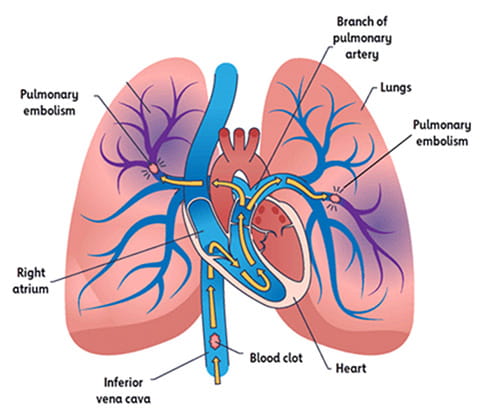
In rare cases, a filter may be placed in the body’s largest vein, called the inferior vena cava. This filter helps keep blood clots from traveling to the lungs.
Your treatment plan depends on where the clot is located, your symptoms and your overall health.
What Is a Pulmonary Embolism (PE)?
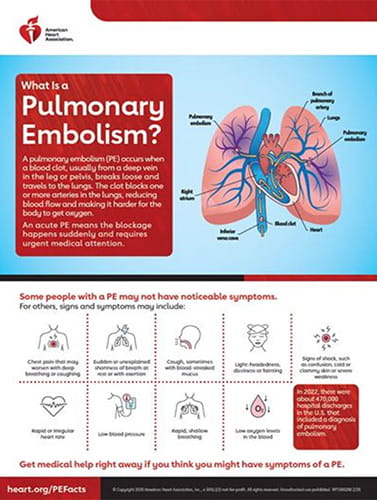
A pulmonary embolism (PE) happens when part of a blood clot breaks loose and travels to the lungs. A PE can become life-threatening and needs immediate medical care.
Symptoms may include:
- Sudden shortness of breath
- Chest pain
- Rapid heartbeat
- Lightheadedness
- Coughing up blood
Call 911 or seek emergency medical care right away if you have sudden shortness of breath, chest pain, fainting or coughing up blood. These may be signs of a pulmonary embolism.
What Causes a Pulmonary Embolism?
A pulmonary embolism (PE) is usually linked to conditions or situations that increase the likelihood of blood clots forming.
Risk factors for PE include:
- Recent surgery or major injury
- Long periods of not moving
- Cancer
- Pregnancy
- Obesity
- Chronic heart or lung disease
- Some autoimmune or inflammatory conditions
- Serious infections
Knowing your risk factors can help you talk with your healthcare team about your risk and ways to protect your health.
How Is Pulmonary Embolism Diagnosed?
To diagnose a PE, a healthcare professional will review your symptoms, medical history and risk factors.
Tests may include:
- A physical exam
- Blood testing, such as a D-dimer test
- Imaging tests, such as:
- CT pulmonary angiogram (CTPA)
- Ventilation-perfusion (V/Q) scan
These tests can help show whether a clot is blocking blood flow in the lungs.
How Is Pulmonary Embolism Treated?
Most people with PE are treated with anticoagulants, sometimes called blood thinners. These medications help keep blood clots from getting larger and help prevent new clots from forming.
Treatment may include:
- Heparin or low molecular weight heparin
- Direct oral anticoagulants (DOACs)
- Warfarin
- Clot-dissolving medications in higher-risk cases
- Procedures or surgery in some situations
How long treatment lasts depends on the size and severity of the clot and your risk factors.
Learn more:
Healthy blood flow is an important part of overall heart health. Small daily habits can help support vascular health over time.
You can:
- Move more throughout the day
- Choose heart-healthy foods
- Manage stress
- Get quality sleep
- Avoid tobacco products
- Keep your blood pressure, cholesterol and blood sugar in a healthy range
- Stay connected with your healthcare team
Knowing your family history and personal risk factors can also help you make informed health decisions.